
Mock data · Built in 5 hoursFrozen snapshot · risk scores derived from a one-time pull of public Alberta sole-source data; they no longer update and should be read as illustrative.
CANveat logoCANveat

Know the vendor before the ink dries.

CANveat puts a caveat on every Canadian government contract — surfacing concentration, amendment creep, and adverse media before a vendor becomes a scandal.

Today’s risk feedOfficial use only

IT / Software

Example Vendor Inc.

CRITICAL
Concentration
9.2
Behaviour
8.4
Adverse
7.1

Captures 84% of one ministry’s sole-source IT spend. Three contracts amended above original bid in 2024. Two adverse-media hits this quarter.

The pattern is recognizable

Recent Canadian procurement scandals share an anatomy.

ArriveCAN, McKinsey, GC Strategies, WE Charity. The data to spot the pattern is already public — federal Proactive Disclosure of Contracts, Alberta sole-source registries, the Integrity Regime ineligible-supplier list, the Lobbying Registry, news media. It just sits scattered across portals, in different schemas, with no canonical vendor identity, and nobody is reading it at decision speed.

How a $0.25M contract becomes a $59M scandal.

ArriveCAN, 2020–2024. Each step is an amendment to the same sole-source contract; each dot is a public adverse-media report; the right edge marks the day federal procurement was suspended.

Horizontal timeline showing the ArriveCAN contract growing from a $0.25 million initial award in April 2020 to roughly $59.5 million by February 2024 through a series of amendments, with three adverse-media events marked in late 2022 and February 2024 and the March 2024 procurement suspension shown as a vertical banner on the right edge.The Globe and MailCBC NewsCBC NewsOffice of the Auditor GeneralGC Strategies banned from federal contracts
  1. 2020-04$0.25M cumulative
  2. 2022-10Globe and Mail: GC Strategies subcontracted nearly all the work
  3. 2022-11OGGO begins parliamentary probe of ArriveCAN spending
  4. 2023-02Auditor General to review the entire ArriveCAN file
  5. 2024-02AG: "glaring disregard" for procurement rules
  6. 2024-02$59.5M cumulative
  7. 2024-03GC Strategies banned from federal contracts
  • A small vendor capturing an outsized share of a category.
  • Contract value growing through amendments without re-competition.
  • Sole-source justifications stacking up, one after another.
  • Adverse media circulating before any internal alarm fires.

How CANveat works

See the risk, understand the reason, choose an action.

  1. Identify

    Canonical vendor identity across CRA, federal, and provincial datasets. The same vendor under five name variants in five tables resolves to one row, one score.

  2. Score

    Composite 0–30 risk across concentration, behaviour, and adverse signals, calibrated against the patterns that surfaced in past procurement failures.

  3. Decide

    Briefing-style UX surfaces one recommended action per flagged vendor and produces a one-click memo formatted to match TBS conventions.
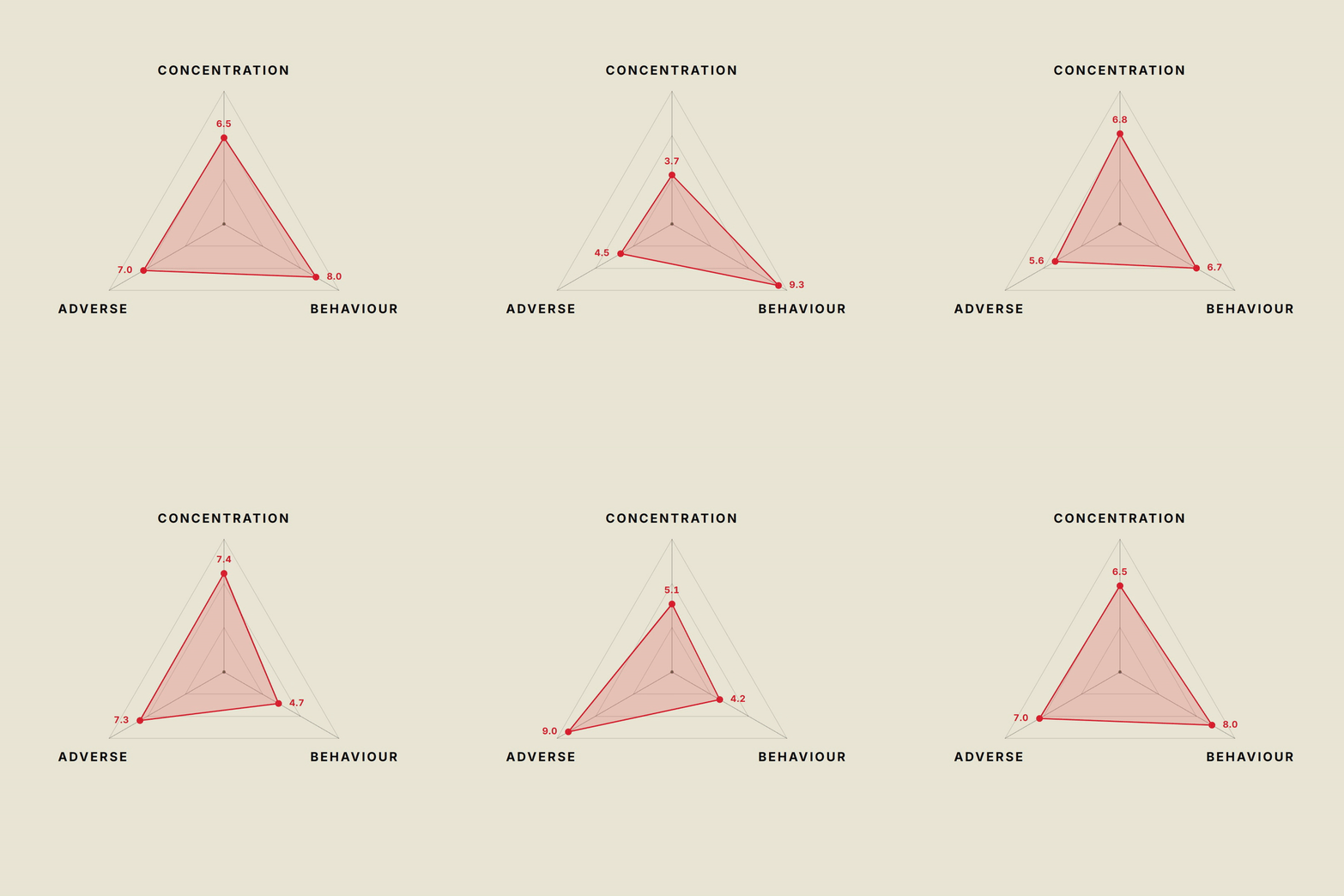
Looping risk-radar chart cycling through four vendor risk profiles. Three axes — concentration, behaviour, adverse — plotted as a polygon.
A vendor’s silhouette. Three axes, scored 0–10, plotted as a polygon. The same shape follows the vendor across the Briefing, the dossier, and any comparison against an alternative.

Use cases

Five places CANveat changes the decision.

Pre-Contract Review

Before awarding or renewing a contract, officers can check whether a vendor shows risk signals worth escalating.

Active Vendor Monitoring

During an active contract, CANveat monitors vendors for emerging issues — adverse media, contract growth, dependency.

Investigation Prioritization

CANveat ranks vendors so officers know what to investigate first.

Alternative Vendor Discovery

If a vendor is risky, CANveat suggests safer vendors in the same procurement category.

Procurement Memo Generation

Officers can generate a formal recommendation memo with risk rationale, recommended action, and supporting alternatives.

Built for

The people who can intervene before a decision becomes a public failure.

Primary

Federal procurement officers

Public Services and Procurement Canada (PSPC), departmental contract-review desks, Treasury Board Secretariat policy staff.

Secondary

Provincial procurement officers

Alberta first, then expanding to other provinces as their open-procurement datasets become readable at decision speed.

Secondary

Departmental auditors and inspectors-general

Internal audit shops with the mandate to investigate, but limited time to triage which vendor relationship to open first.

Tertiary

OPO, OAG, and OGGO

Office of the Procurement Ombudsman, Office of the Auditor General, and Standing Committee on Government Operations and Estimates research staff.

Adjacent

Public-interest readers

Investigative journalists, accountability academics, and civic-tech contributors. Same data, narrower permissions, no memo generation.

About CANveat

A hackathon project taking accountability seriously.

CANveat was built for Agency 2026 — Ottawa, the Government of Alberta’s national AI-and-accountability hackathon (April 2026). The pan-Canadian framing leads with Alberta procurement data because it is the only true procurement-shaped open dataset in the provided platform, and the hosting context makes the alignment intentional.

Built by the CANveat hackathon team — names to be added.

Open-data attribution

  • open.canada.ca — Federal Proactive Disclosure of Contracts, Grants & Contributions, Integrity Regime list.
  • open.alberta.ca — Alberta sole-source contract registry and grants.
  • Data preparation pipelines from the in-tree dataset-analysis-platform/.

Open the Portal and see the risk feed.

No login. The data is open; the briefing is one click away.

Open the Portal